
If your child finds reading or spelling difficult, multisensory learning can give them the boost they need to get back on track.
Before we explain how it works, it helps to understand what’s happening in the brain when a child learns to read.
Contents:
- Reading is Not Natural for the Brain
- How Multisensory Input Builds Stronger Reading Pathways
- Why Hands-On Activities Help Beginning Readers
- Multisensory Activities for Home or the Classroom
- Connecting the Pieces to Support Learning at Home
- From Effortful Reading to Automatic Reading
Reading is Not Natural for the Brain
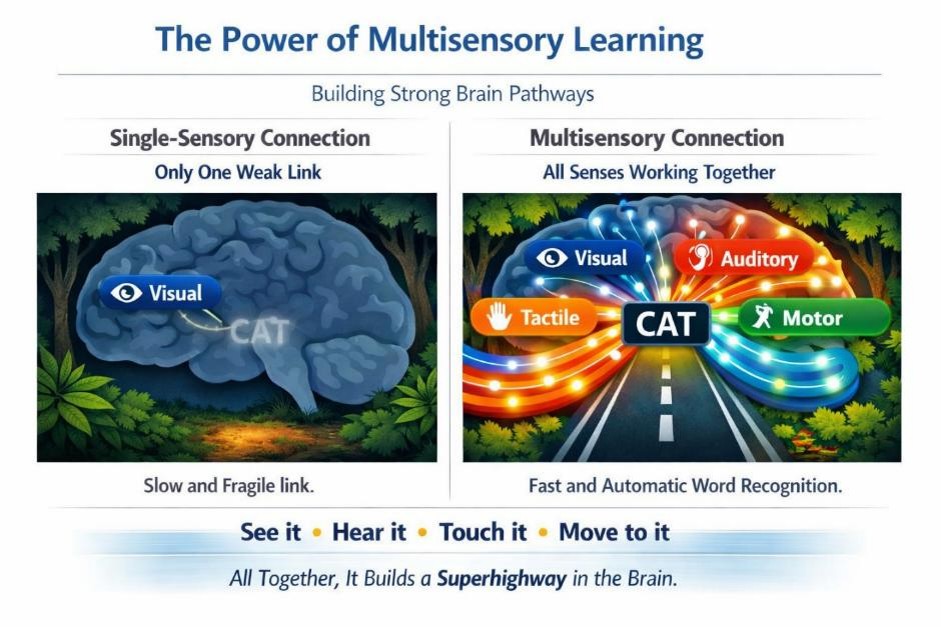
We explain this in more detail in our article, ‘Why Learning to Read is Difficult‘. However, a simple analogy is to think of your child’s brain as a dense, tangled forest. Learning to read a word is like trying to clear a path through that forest:

- The First Attempt: The first time your child sounds out a word, there is no path at all. Pushing through the thick undergrowth is slow and tiring, and it takes a huge amount of mental effort. This is why reading can leave them feeling worn out or frustrated.
- The Single‑Sensory Path: If we only show a child a word on a page, they’re relying on just their eyes. Their brain forms a tiny, fragile trail rather than a clear path. When they’re tired, distracted, or stressed, that faint trail can quickly disappear — and suddenly they “forget” the word they knew yesterday.
How Multisensory Input Builds Stronger Reading Pathways
Multisensory learning involves seeing, hearing, touching, and moving all at the same time.
When a child:
- sees the letters
- hears the sounds
- touches and moves alphabet cards while building the word, or traces the word
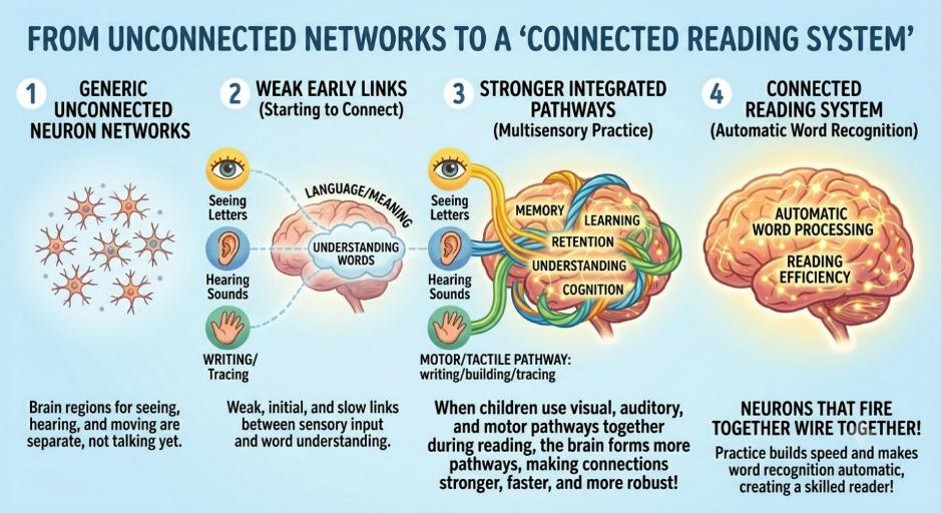
…several regions in the brain are activated simultaneously, and the nerve cells (neurons) in different areas interconnect. Neuroscientists tell us, ‘neurons that fire together wire together.’
So, essentially, multisensory activities help rewire the brain, and the extra connections build a stronger, more reliable reading pathway.
The signal from a single sensory input is weak because it travels along a thin, isolated ‘wire’. With multisensory inputs, several ‘wires’ join together to form a thicker, more robust connection which:
- speeds up processing
- strengthens memory
- provides backup routes if one sense falters
- makes reading feel easier and more automatic
Why Hands-On Activities Help Beginning Readers
For young readers, phonics concepts like phonemes, graphemes, blending, and segmenting can feel very abstract. However, when children build words with alphabet cards or write them on paper, these ideas become more concrete and easier to understand.
This matters because research suggests that abstract ideas can place heavy demands on a child’s working memory. Concrete examples and hands-on activities provide additional support, helping children focus on understanding sounds, letters and words without becoming overwhelmed.
Over time, this can help children develop greater confidence, reading fluency and comprehension.
Multisensory Activities for Home or the Classroom
These activities can be done using magnetic letters or alphabet letter cards.
Blending – ‘Pushing the Sounds’ Together
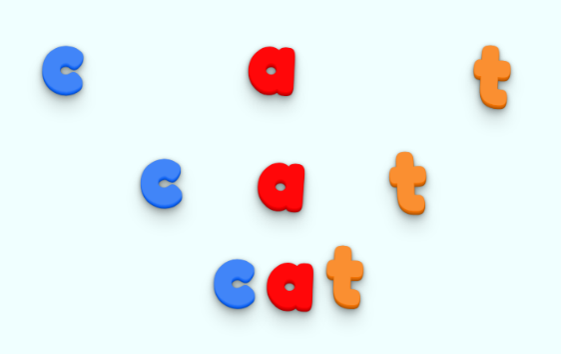
Children begin by saying each letter sound separately. As they do this, gradually move the letters closer together. Each time you slide the letters in, encourage your child to shorten the pause between the sounds.
As the letters get closer and the gaps between the sounds shrink, the word becomes easier to hear. Finally, ask your child to blend the sounds into the whole word.
Letter Swap Blending
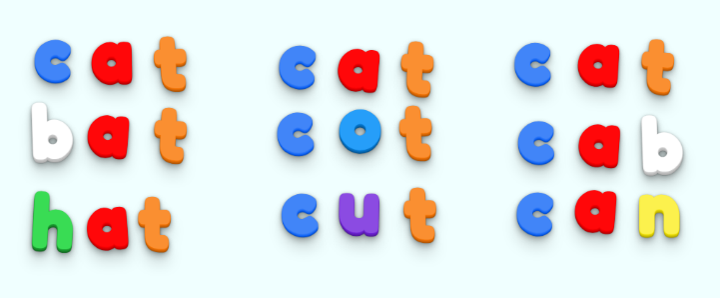
Start with a simple word, such as cat and ask your child to blend it.
Next, swap the first letter for a different one. (It helps to choose the letters beforehand.) Ask your child to blend the new word.
This shows them how changing just one letter creates a completely new word.
Repeat with a few more first‑letter swaps. Once your child understands the idea, you can also try swapping the middle or final letters, as shown below.
Manipulating the letters and sounds in words using activities like this strengthens phonemic awareness and helps children notice patterns in words. It also encourages flexible thinking, which supports problem‑solving.
As well as substituting letters, you can also add or remove them. For example, adding s to lip to make slip, or removing s from stop to make top.
Guided Writing
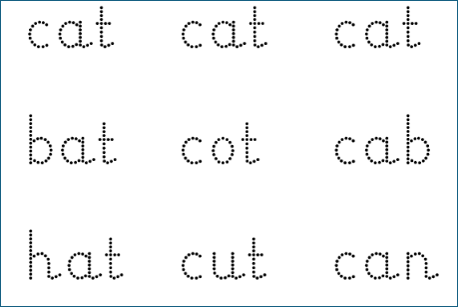
Guided writing worksheets can be tailored to practise the same words children have built with movable letters. The example below shows a guided writing activity designed to accompany the Letter Swap Blending activity.
Some children benefit from heavier guidance at first (dotted tracing), while others are ready for lighter visual support using outlined letters.
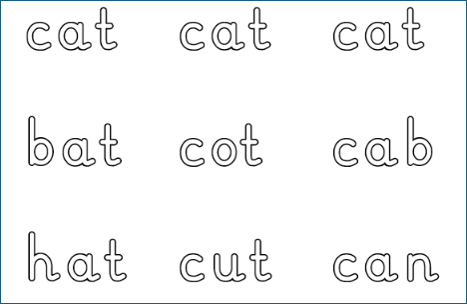
People often think of writing as separate from reading, but the two skills are closely connected. In many ways, writing is like reading in reverse. Brain imaging studies suggest that both reading and writing activate areas of the brain involved in processing sounds and language.
Writing is also a powerful multisensory activity. As children write, their hands, eyes and inner voice work together, helping to strengthen reading and spelling pathways.
However, many children find writing difficult or frustrating because it relies on fine motor control as well as spelling knowledge. Without guidance, children may also form letters incorrectly or develop insecure spelling habits.
Tracing dotted letters can reduce frustration while still reinforcing letter formation and the muscle memory of spelling patterns.
If you don’t have guided writing software, you can print words in a faint grey font for children to trace. Try to choose a font that resembles your child’s handwriting style. In particular, avoid fonts with a more complex letter a, which can sometimes confuse beginning readers. Comic Sans or Cavolini work well, and some other simple fonts may also be suitable.
Segmenting
Segmenting is an essential skill for spelling.
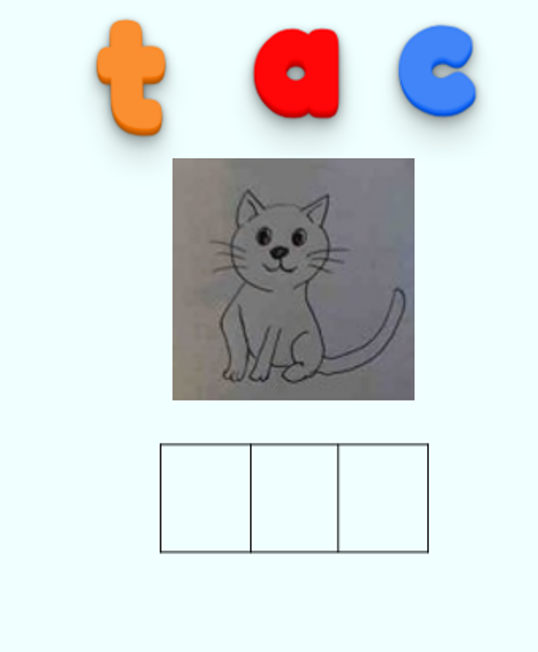
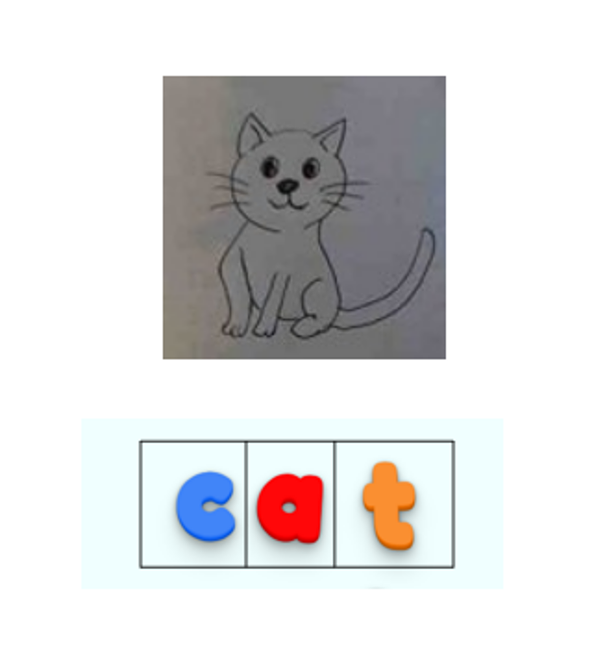
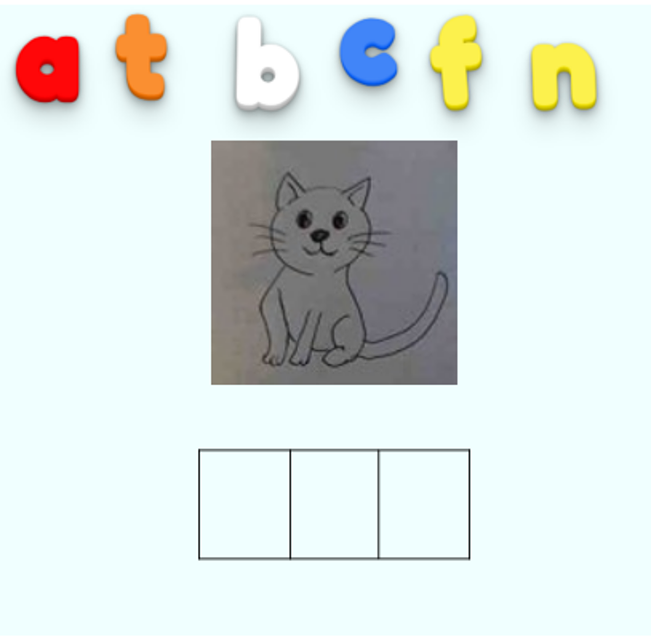
Give your child a picture or say a simple word. Ask them to listen carefully for each sound and pull down the matching letters one by one.
A helpful way to support them is to draw boxes or dots to show how many sounds the word contains. This gives children a visual guide and reduces the load on working memory. Children look at the picture, say the word aloud, and then pull down the letters into the boxes as they identify each sound.
You can also start with the correct letters placed in the wrong order, or add a few extra letters to increase the challenge as their confidence grows.
Other Multisensory Activities
Examples of alternative multisensory activities used by teachers include:
- tracing letters in a tray of sand, shaving cream, or on sandpaper
- “air-writing” letters using their whole arm,
- or tapping out the sounds on their fingers.
If you’re looking for something different, check out our blending page, where you will find videos on ‘drive-through blending’ using a toy car and blending with a piece of knotted string!
Connecting the Pieces to Support Learning at Home
A Sample 10-Minute Routine
Here’s a simple routine to implement some of these ideas if you are short of time.
Step 1: Build It (2 Mins)
Use the letter cards to build a target word. For example, “fish.”
Talk about the sounds.
Step 2: Swap It (3 Mins)
Change “fish” to “dish” or “fist.”
Have the child physically move the cards to see the change.
Step 3: Write It (5 Mins)
Move to the guided writing worksheet.
Have the child trace and write the phrase “a fish,” saying the sounds aloud as their pencil moves.
Why this works so well:
By the time your child puts pencil to paper on the worksheet, their brain has already processed that word visually, auditorily, and physically through the letter cards. The worksheet isn’t just “busywork”— it’s the final layer that cements the new neural pathway in place.
From Effortful Reading to Automatic Reading
We’ve seen that multisensory learning can be effective, but it’s not a magic bullet. It still takes a lot of practice before children develop automatic word recognition.
Regular practice produces a substance called myelin in the brain. This wraps around the nerve fibres, forming an insulating layer. Just like the plastic coating around an electrical wire, it protects the nerves and allows electrical signals to travel faster and more efficiently.
However, automatic word recognition and fluency aren’t enough on their own. Children also need to understand what they are reading. We discuss ways to improve their understanding in our articles on reading comprehension.